
Cousins
The word cousins is commonly used to refer to the relationship between the children of siblings. It is also used to refer to those who are not members of the immediate family and are distant cousins. This simple catch-all term helps to avoid the use of more complex ones such as third cousin twice removed and second cousin once removed. But what do these terms really mean?
Before we get into the more complex terminology, let’s start with the simple ones. When identifying cousins within a family, the important thing to remember is that they have common ancestors.
Consider this simplified family tree showing three generations of the same family:

Here, your cousins are the children of your aunt and uncle and are in the same generation as you. Because of this, you both share a set of grandparents; the common ancestors at the top of the tree. Strictly speaking, those who share grandparents are called first cousins but we just call them cousins.
Now, should you and your cousin both have children, then the tree will grow by a generation and look something like this:

The children of the first cousins are called second cousins. They are of the same generation and have common ancestors; their great-grandparents. This new generation means that your parents are now grandparents and your grandparents, at the top of the tree, are now great-grandparents.
Continuing this pattern, the children of second cousins are third cousins who share a set of great-great-grandparents, their children will be fourth cousins with the same great-great-great-grandparents, and so on. The common misconception is to refer to the child of your cousin as your second cousin but this isn’t son because you are not from the same generation as each other.
So how do we describe the relationships between those in different generations? Well, this is when we use phrases such as once removed. For example, a child of your first cousin is your first cousin once removed. The phrase once removed refers to the fact that you and your cousin’s child are a generation apart and because of this the common ancestor has a different relationship. Your grandparents are the great-grandparents of your first cousin once removed. Should your cousin’s child then have a baby, this child would be your first cousin twice removed as you are two generations apart.

Other cousins can also be removed in the same way and can be seen if the family tree is expanded to include include your second cousins:

Identifying the relationship of those in the generations below is straight forward as each subsequent generation becomes one more removed than the previous. The child of your second cousin is your second cousin once removed, and their child is your second cousin twice removed, and so on. But what about identifying the relationship of those in the generations above you. Notice in the tree above that the parents of the second cousins have not been identified yet and are simply labelled with a question mark.
As we have already noticed, labelling downwards is fairly easy, so in order to identify the parents of your second cousin we’ll move up a generation so that we can move down to identify the relationship. In the tree below, we can see that the parents of your second cousin are, in fact, first cousins of your parents as they are in the same generation and share the same grandparents. Working downwards, the relationship between you and your parent’s cousin is therefore first cousin once removed.
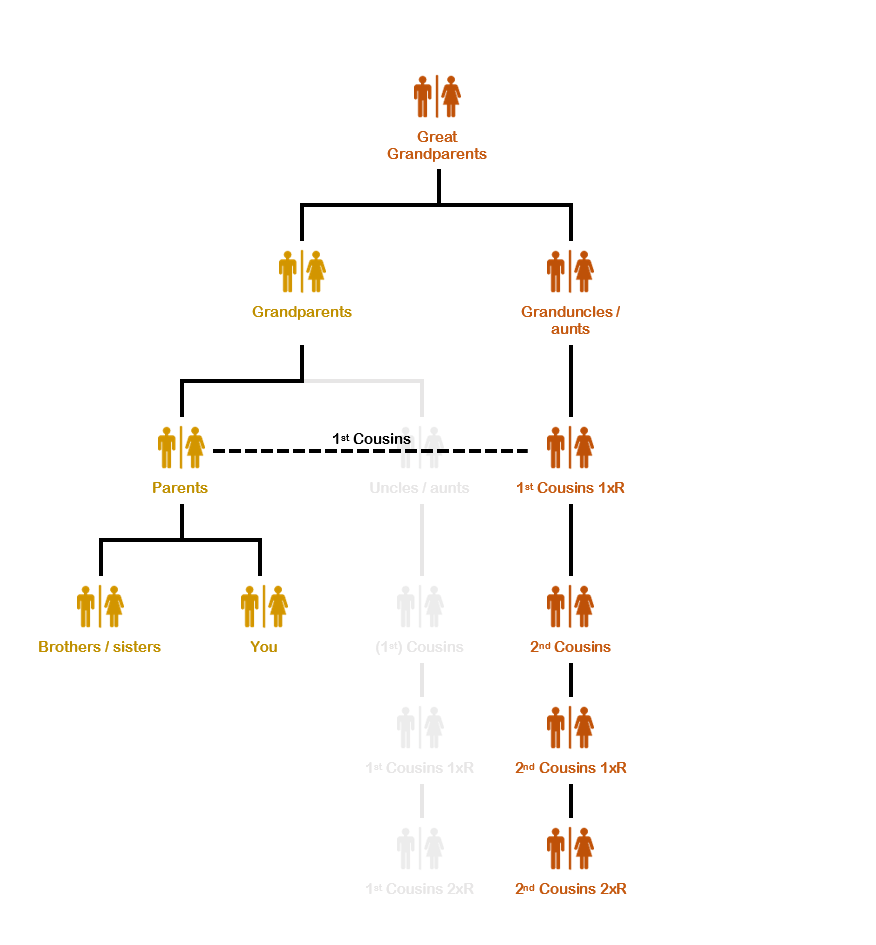
So all cousins are from the same generation and have ancestors in common, and they become removed when they are from different generations.
Cousin Chart
A reference chart to help determine relationships can be downloaded as a single pdf file. It displays all the cousin relationships covering nine generations.