
Understanding the Gregorian Calendar
The Gregorian Calendar better aligns with the timing of the Earth’s orbit around the sun, known as the solar calendar. It improves the Julian Calendar and is more accurate in keeping in line with the solar calendar and the seasons. Over time, the Julian Calendar had over compensated in trying to do this by adding too many leap days. As a consequence, the introduction of the Gregorian Calendar meant losing some days.
The Julian Calendar assumes the length of the solar year to be 365¼ days. It therefore has 365 days and makes up for the missing ¼ day by adding a day every four years. However, the solar year is actually less than 365¼, so adding a whole day every four years is too much. After 128 years, the calendar is ahead by a whole day. There is more information about this on the page about leap years and leap days.
The Gregorian Calendar
Pope Gregory XIII introduced a more accurate calendar that adds fewer leap years. Basically, over a 400-year period, it removes three leap years. It was first adopted in 1582 and by now, the Julian Calendar and the solar calendar differed by 10 days. Switching from the Julian Calendar to the Gregorian calendar caused the loss of these days, and the day after Thursday, October 4, 1582, became Friday, October 15, 1582.
However, not all countries adopted the new calendar at first, and it took over 300 years for other countries to follow. France, Spain and Portugal were amongst the first to switch in 1585. Greece was one of the last in 1923.
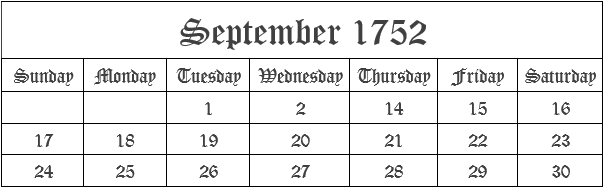
By the time the United Kingdom switched in 1752, the Julian Calendar had acquired an additional eleven days. It was decided that these should be taken from September and, as can be seen in the calendar below, Wednesday 2 September was followed by Thursday 14 September. It is believed, but not proven, that losing the eleven days caused riots in the UK as people mistakenly thought they had lost eleven days of their lives.
Until 2099, the Julian Calendar will be 13 days out with the Gregorian Calendar. In 2100 the difference will become 14 days.
Today is 4th October 2026
On the Julian Calendar, it is 21st September 2026
The Gregorian Calendar is not perfect, although it is more accurate than the Julian Calendar. It can be out by one day every 3,323 years, approximately, but, with variables at play in outer-space, this could be as much as one day in every 7,700 years!


